The Ultimate Guide to A-dec Dental Chair Repair in Vancouver for Critical Failures
A-dec Dental Chair Repair in Vancouver Keeping Your Dental Practice Running Smoothly
A-dec Dental Chair Repair is a vital service for any busy dental clinic. If you’re a Vancouver dentist or clinic manager, you know how disruptive a malfunctioning chair can be. Not only can it throw off your schedule, but it also creates stress for both staff and patients . We understand the frustration and urgency when an A-dec chair isn’t working correctly. In this blog, we’ll share the most common A-dec dental chair problems we see, along with maintenance tips and solutions, to help you stay ahead of issues. Our goal is to keep your operatory running smoothly so you can focus on patient care.
Common Issues That Require A-dec Dental Chair Repair in Vancouver
Even a top quality chair like A-dec can develop issues over time. In fact , A-dec’s own service guides acknowledge that chairs may occasionally stop or behave unexpectedly. Many Vancouver clinics call us for A-dec Dental Chair Repair due to a handful of recurring problems. Below, we delve into these common issues from hydraulic lift failures and unresponsive foot pedal to worn upholstery and electrical glitches , and explain how to address them.
One frequent problem are when an A-dec chair will not lift or slowly drifts down on its own. This usually points to a hydraulic system issue. A-dec chairs use hydraulic cylinders to raise and lower the chair, and if a seal wears out or fluid leaks, the chair may lose pressure and start sinking. Unplugging the chair is a quick test if it continues to drift downward with no power, the hydraulic circuit is likely at fault. The A-dec service guide advises checking for hydraulic fluid in the vent lines if pinching off a vent line stops the drifting, it means the lift cylinder is leaking internally and needs replacement. If the drifting doesn’t stop, the issue could lie in a valve: for example , a faulty solenoid plunger with a worn rubber tip can allow fluid to bypass and cause the chair to drop. In simpler terms, our BioDen technicians often find that fixing a drifting or non lifting chair involves either replacing a worn hydraulic cylinder or repairing a leaky hydraulic valve. We’ve also seen cases where the chair goes all the way up and gets stuck at the top scenario known as hydraulic lock. This can happen if an upper limit switch is misadjusted or fails to trip essentially, the pump keeps pressurizing the lift cylinder with nowhere to go. The result is a chair that won’t budge (almost like it frozen at full height).Our A-dec Dental Chair Repair in Vancouver service frequently handles these hydraulic lock situations by readjusting or replacing the faulty limit switch and carefully releasing the trapped pressure. In any case, hydraulic problems can be messy (with potential oil leaks on your operatory floor) and dangerous if not addressed, so it’s best to have a trained BioDen technician diagnose and fix these issues promptly.
Another common call we get is when the A-dec chair’s foot control stops responding. The foot pedal (footswitch ) is the primary way dentists and assistants move the chair during treatments, so if pressing it does nothing, work grinds to a halt. There are a few typical causes for this. Often, the footswitch itself can wear out or its wiring can get damaged from years of use and movement. In other cases, the issue isn’t the pedal but the chair’s electronics a blown fuse or a faulty circuit board can also make the chair unresponsive to controls. A-dec chairs have fuses and a main control PCB (printed circuit board) in the base; if a fuse (for example, the solenoid fuse that powers the hydraulics) is blown or a relay on the PCB fails, the chair might not move at all. The A-dec service guide troubleshooting charts point out that “a blown power or solenoid fuse ” or “ a faulty controller PCB or footswitch” are prime suspects when a chair is completely inoperative. In our experience providing A-dec Dental Chair Repair in Vancouver, we find that something as simple as replacing a fuse or the foot pedal unit can sometimes bring a “dead” chair back to life. Other times, we may need to replace the control board if it has failed.
Quick tip: Always double check the chair’s power sources if the foot pedal does nothing. Ensure the chair is plugged in and its main power switch is on, and verify that the circuit breaker on the chair’s base hasn’t tripped. We’ve had service calls where the only issue was that the chair was accidentally unplugged or the mains switch was off. Also examine any indicator lights on the chair’s base electronics. For instance, some A-dec models have a status LED on the board if it’s off despite power being supply, that could indicate a board fault or blown internal fuse. If basic checks don’t solve it and the foot pedal still doesn’t respond, it’s time to call BioDen. We’ll send an experienced BioDen dental chair technician to your Vancouver office to pinpoint whether the culprit is the foot control, a wiring connection, or an internal electronic component, and get it fixed.
Modern A-dec chairs often include electronic touchpads or control panels (sometimes mounted on the chair or delivery system) that allow programming of chair positions and integration with other dental unit functions. If the chair’s electric control panel isn’t working or the preset position buttons don’t respond, the cause can be similar to the foot pedal issues bad connection, a software glitch, or a board fault. In some cases, reprogramming the chair’s positions or power cycling the unit can clear a minor glitch. However, a persistent A-dec chair control panel fault usually requires professional repair. We handle these electronic issues by diagnosing whether the fault lies in the panel itself, the communication wiring, or the chair’s main board.
Additionally, A-dec chairs use various limit switches (safety switche) to stop movement at the end of travel ranges and to prevent collisions. If a limit switch gets stuck or misaligned, you might find the chair won’t move in a certain direction or it stops too soon. For example, if something gets lodged under the chair base or the assistant’s arm is out of position, a safety limit will cut power to prevent crushing. A common scenario is the chair won’t go down because it “thinks” something is underneath ,when in reality the limit switch could be faulty. Conversely, as mentioned earlier, a failed upper limit switch might not stop the motor when the chair reaches its top position, leading to the hydraulic lock issue. The troubleshooting manuals note that an improperly adjusted or faulty limit switch can indeed lead to hydraulic lock or other malfunctions. Our technicians at BioDen test each limit switch during service and replace them if needed. We also inspect the wiring to these switches on the circuit board, since sometimes a loose connector can mimic a bad switch. Addressing these electrical and switch issues is all part of our comprehensive A-dec Dental Chair Repair in Vancouver service.
Upholstery and Armrest Issues: Not every chair problem is hightech; some are just the result of daily wear. A-dec chairs are built to last, but over years of heavy use in a busy Vancouver practice, parts like the upholstery and armrests may need attention. One common service we provide is replacing worn upholstery. The plush vinyl or leather cushions on the seat and back can crack or rip over time, especially at the seams or edges where cleaning chemicals might degrade them. Worn upholstery isn’t just an aesthetic issue cracks can harbor bacteria and make cleaning difficult , not to mention it gives patients a poor impression. BioDen offers upholstery replacement as part of our A-dec Dental Chair Service Vancouver package, giving your chair a fresh, like new look and comfortable feel. We use high quality materials and can match the color so your operatory maintains a professional appearance.
Another annoyance is stuck or loose armrests. A-dec chairs often have movable armrests to help patients get in and out. Earlier models may have two fixed positions (up or down), and newer ones can even swivel or articulate. If an armrest gets jammed and won’t swing out of the way, or if it has become too loose and won’t stay put, it likely just needs a simple adjustment rather than an expensive repair. The A-dec service guide for the 300/500 series notes that armrests come locked from the factory but can be unlocked for easier access. It even explains that if the unlocked armrests become loose or hard to move, the rotation tension can be adjusted with an Allen wrench (hex key) by tightening or loosening the tension screw. We perform this adjustment often during A-dec chair maintenance in Vancouver calls. Essentially, we remove a small set screw that locks the armrest, allowing it to rotate, and then fine tune the tension so the arm moves smoothly without flopping. If an armrest is truly stuck due to a broken internal pin or hinge, we can repair or replace that mechanism as well. Similarly, headrests, swivel locks, and brake pedals (if your chair has a swivel base) can all be realigned or fixed by our BioDen team. These little comfort features are important for daily workflow, and fixing them is usually quick and coste ffective.
Sometime a chair is working but making concerning noises perhaps a loud whining from the motor or a squeaking during movement. Unusual sounds are often an early warning sign for an issue. A common cause is lack of lubrication. The hydraulic lift cylinder in A-dec chairs should have a lightly greased shaft; if it dries out, you might hear a squeal or rubbing sound each time the chair goes up or down. A-decs troubleshooting guide suggests checking the hydraulic cylinder shaft and applying lubricant if the chair “makes an abnormal noise when moving” . Another thing to listen for is the hum of the pump motor if the motor runs but the chair doesn’t move, that could indicate the pump is straining against a blockage or a valve that isn’t opening (again, possibly a sign of a solenoid issue or hydraulic lock). Rattling or clunking noises might simply be a loose cover or hose. We’ve had service calls where the solution was as easy as securing a loose hydraulic hose that was vibrating against the chair frame. During any A-dec Dental Chair Repair in Vancouver visit, our technician will not only fix the primary complaint but also tighten any loose bolts, quiet any rattles, and top off hydraulic fluid if it’s low (low fluid can introduce air into the system and cause noise or jerky motion). Through regular maintenance, you can avoid many noise related problems a quick tuneup and lubrication go a long way toward keeping your A-dec chair whisper quiet and smooth.
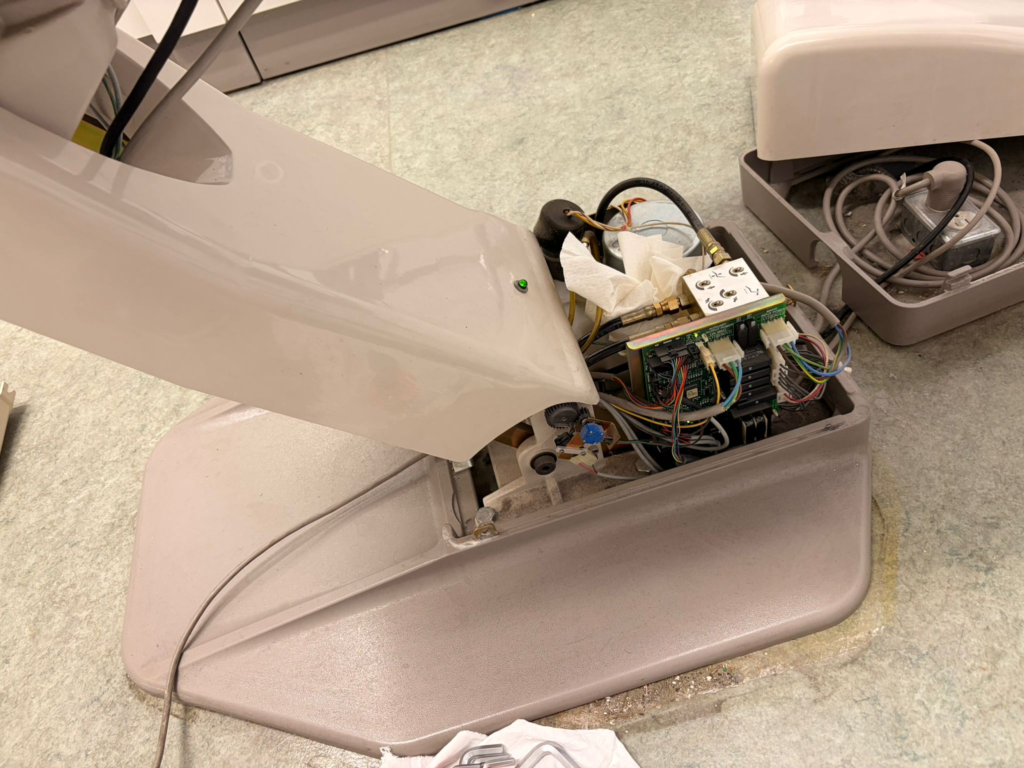
For instance, an open A-dec chair base reveals the circuit board (green board on the left) and hydraulic valve block (white manifold on the right) that a technician checks during troubleshooting and repairs.
Troubleshooting Tips for A-dec 300 and 500 Series Chairs
Even within A-dec’s lineup, different models have unique quirks. The popular A-dec 300 series (which includes models like the A-dec 311 and 411) and the premium A-dec 500 series (model 511 and variants ) share many design elements , but there are some differences in their control systems. Here are some troubleshooting tips specific to these A-dec chair serie
Both the 300 and 500 series chairs have a safety feature that activates if a position sensor (potentiometer or inclinometer) fails. If your chair’s preset buttons suddenly stop working and the chair only moves in small bursts (about one second at a time), it has likely entered a limp-along mode. This mode allows limited movement so you can at least reposition the chair enough to safely finish with a patient. The A-dec manual indicates that if a position sensor fails, “the limp-along feature allows the operator to position the chair in one seconde intervals by pressing the manual control buttons”. In practice, if you notice this behavior (only incremental motion), it means a limit potentiometer or sensor might be bad. You can still move the chair step by step, but you should call a technician to replace the faulty sensor and recalibrate the chair.
On A-dec chairs (especially 511 and similar models) , a base stop plate or safety switch under the chair will halt movement if pressed (for example, if it contacts an obstacle on the floor). If your A-dec 511 chair won’t lower, first ensure nothing is actually underneath and pressing the safety plate. Likewise, make sure any chair lockout features (such as the foot control’s stop or a chair stop toggle) is not engaged inadvertently. The A-dec 511 chair has a stop switch LED on its circuit board that lights when a safety switch is tripped. Clearing obstructions and resetting the stop plate can often restore normal function if the chair was in a protective lockout.
The A-dec 511 chair’s main board includes diagnostic LEDs that can help pinpoint issues. For example, DS1 is the AC power indicator LED on the board. If your chair is completely non responsive (no movement, no sounds ), check if the board’s AC power LED is lit. If not, you may have a tripped breaker or a blown fuse. The A-dec 511 uses a 300 watt power supply with multiple circuit breakers (often labeled CB1 through CB6) for different functions. Locate the breakers (usually on the power supply in the chair base) and see if any have tripped reset them if so. The service guide suggests unplugging various outputs and retesting, to isolate which circuit might be causing a breaker trip. For any A-dec 500 chair troubleshooting, always ensure the mains power and breakers are OK before delving into more complex diagnostics.
In both A-dec 300 and 500 series, a “ no movement” scenario can sometimes be traced back to the controls rather than the chair mechanics. If the chair isn’t responding to the foot pedal, try using the touchpad (if your chair has one on the delivery unit) or vice versa. A damaged foot control cord on an A-dec 300 series chair, for instance , could make it seem dead when the touchpad might still operate it. A quick swap or test of the footswitch can save a lot of time. Similarly, check that the data cable connecting the touchpad or foot pedal to the chair is securely connected (on models where they plug into the chair base). The service tips for the 311/411 chairs advise connecting a known good data line or control to test whether the original is faulty. In summary, confirm the control device is working before assuming the chair itself has failed.
The A-dec 300 serie ( 311/411) uses a hydraulic base lift and typically an electro-mechanical motor for the backrest. The 500 series (511) uses hydraulic actuators for both base and back, with position sensing via inclinometers. If a specific motion isn’t working say the base won’t lower one common cause is a bad solenoid valve coil for that motion. For example, if “No Base Down” is the issue, the service guide suggests checking the base-down solenoid coil for magnetic pull or correct resistance (about 38Ω ±4Ω) and replacing it if defective. Similarly, if the chair’s base goes up but not down, or stops after a second, always consider the limit switches and sensors as discussed. For A-dec 500 chair troubleshooting, note that these models have inclinometer sensors for position feedback after replacing such a sensor or a board, a factory default routine (calibration) may be required to recalibrate the chair’s positions. This is something a BioDen technician would perform after a repair to ensure presets and limits are set correctly.
Some A-dec chairs are designed with safety interlocks tied to the delivery unit. A prime example: on certain A-dec systems, the chair will not move if a handpiece isn’t fully seated in its holder this is a builtin safety feature to prevent cords from snagging or tools from flying if the chair moves. So if your chair seems stuck, double check that all handpieces, the air/water syringe, and any attached accessories are properly placed in their holders. It sounds simple, but we’ve encountered cases where a chair “ wouldn’t move” and it turned out a handpiece was slightly out of its cradle, triggering an interlock. Little things like that show how integrated the chair and delivery systems are on A-dec equipment.
Keep in mind that while these troubleshooting tips can help you identify or even resolve minor issues, critical failures ( especially involving electronics or hydraulics) should be handled by a professional. If you’re ever in doubt, it’s safer to call for expert help rather than risk injury or further damage to your chair.
Preventive A-dec Chair Maintenance and Delivery System Service in Vancouver
While we’re always here to provide A-dec Operatory Chair Repair Vancouver when an urgent problem arises, The best way to deal with critical failures is to prevent them in the first place. Regular preventive maintenance not only reduces the likelihood of breakdowns but also extends the life of your A-dec dental chairs. Below is a practical preventive maintenance checklist including daily routines for staff and periodic checks that a technician should perform to keep your A-dec chair in top shape check BioDen Maintenance page
Preventive Maintenance Tips for Your A-dec Dental Chair
Keep Your A-dec Chair in Top Shape with These Preventive Maintenance Tips!
Inspect & Lubricate
- Check and lubricate hydraulic and moving parts regularly.
- Prevent wear and noisy operation.
Test Foot Pedals
- Test foot pedals and control panels.
- Ensure all controls respond smoothly.
Check Electrical Systems
- Inspect fuses, wiring, and connections.
- Avoid sudden electrical failures.
Examine Upholstery
- Watch for wear and tear on cushions.
- Replace worn upholstery to keep chairs comfy.
A-dec Chair Maintenance Checklist
Keep Your A-dec Dental Chair in Optimal Condition with Regular Maintenance.

Daily Cleaning and Inspection
• Wipe down upholstery and chair surfaces daily using non corrosive, approved disinfectants.
• Avoid harsh chemicals that could degrade vinyl or leather.
• Check around the base and hydraulic lines for signs of fluid leaks or puddles.
• Test foot pedal functions (up, down, tilt) and listen for unusual noises or jerky motion.
• Spot early signs of drift or slow movement to avoid chair failure mid procedure.

Weekly Maintenance
• Lubricate any moving parts (if applicable ), such as arm joints or lift mechanisms.
• Inspect foot control cables, power cords, and tubing for signs of wear or kinks.
• Look for cracks or bends in umbilical hoses between the chair and delivery system.
• Clean suction lines , filters, and strainers in the oral rinsing bowl or delivery unit.
• Ensure all chair controls (buttons, foot pedals) respond promptly and smoothly.

Monthly Checks
• Test safety stop plates and preset buttons to verify they stop and reset chair motion correctly.
• Inspect upholstery for cracks, rips, or separation replace or repair as needed.
• Verify headrest locks and releases properly , and check swivel brake holds position.
• Check the hydraulic fluid level if your model includes a sight glass or reservoir.
• Confirm limit switche and sensors are engaging at the right height and travel points.

Annual Professional Service
• Conduct a full inspection of hydraulic cylinders, solenoids, and valves for leaks or wear.
• Top off and replace hydraulic fluid as needed to maintain lift performance.
• Inspect and test all circuit boards, sensors, and limit switches.
• Perform firmware updates and control recalibration if supported by your A-dec model.
• Service delivery unit : clean control block, adjust tension arm, and inspect handpiece tubing.
• Provide a full operatory diagnostic report and recommend preventive upgrades.
Real A-dec Dental Chair Repairs Completed by BioDen in Vancouver
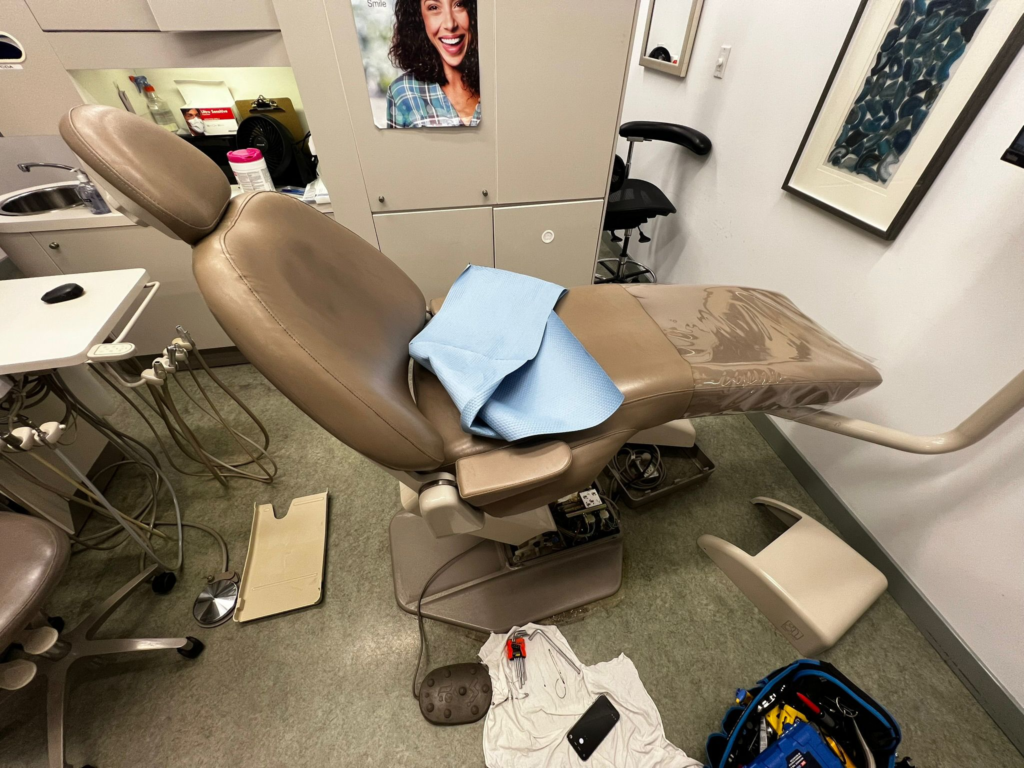
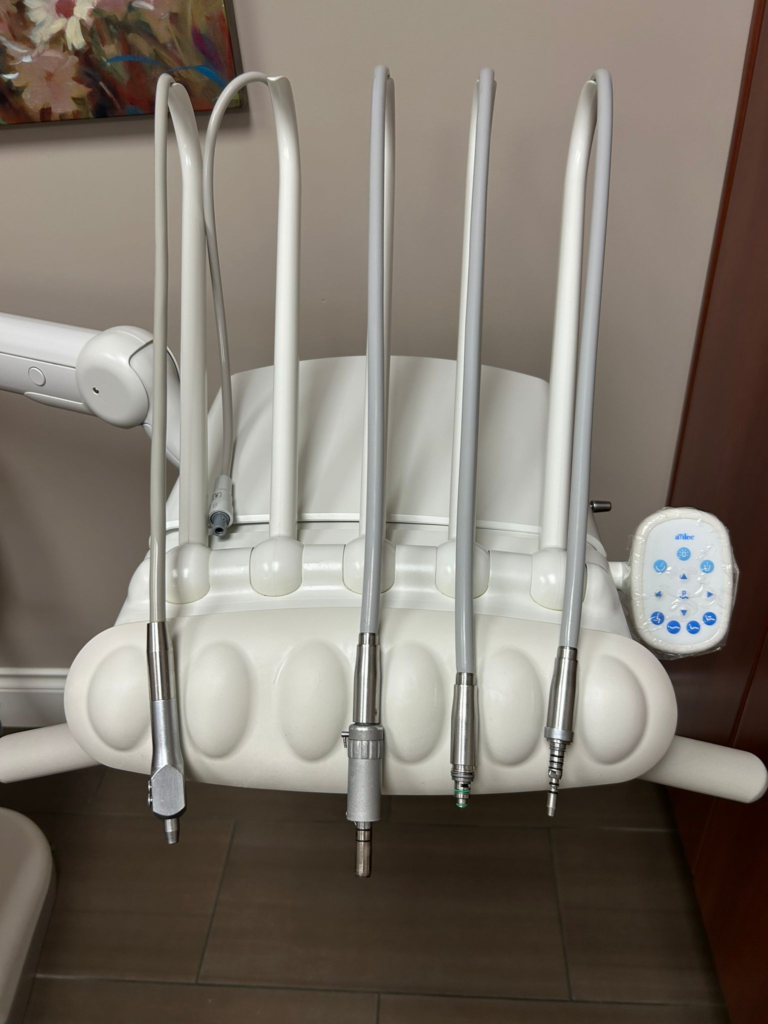
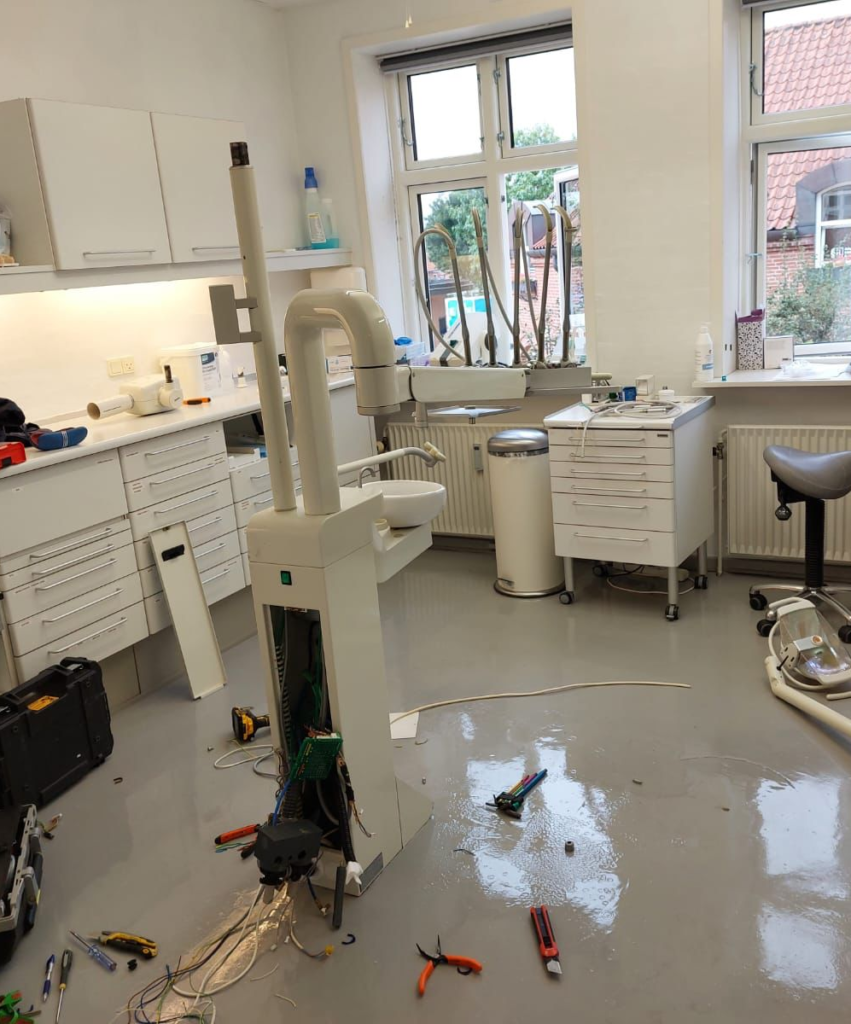
these are real examples of A-dec dental chair repairs completed by BioDen for clinics across Vancouver and the surrounding areas. These cases include hydraulic repairs, chair lift failures , foot pedal issues, control panel troubleshooting, and full operatory chair restorations. All images represent actual service visits performed by our certified technicians using original A-dec parts and proven repair methods.